
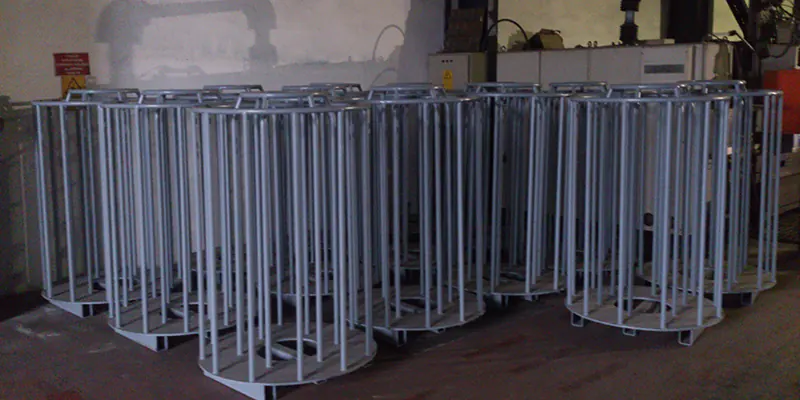
WIRE BASKET
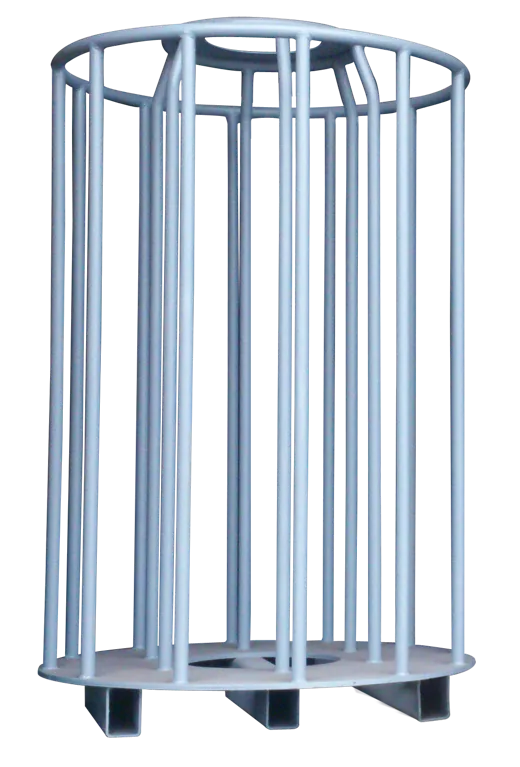
There is no standard for wire baskets; each basket is manufactured to the required dimensions. They are used in the production and transport of copper, aluminium and tinned wire.
- Dimensions specified by the customer
- For copper, aluminium and tinned wire
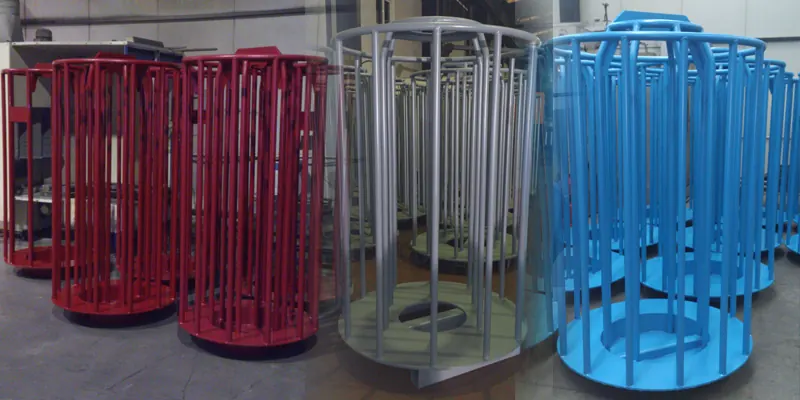
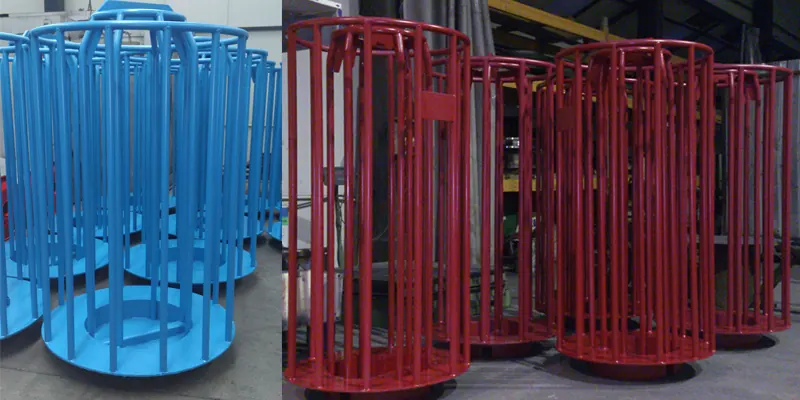
- Painted on request
Applications and technical rationale
Coilers
Why? Wire leaving the drawing line is laid into the basket in rings instead of being wound onto a reel barrel. The central cone keeps the rings concentric and prevents the coil from collapsing inwards, so large coil weights can be collected without stopping the line for a reel change.
Annealing furnaces
Why? The open cage allows protective gas and heat to circulate through every part of the coil; with a lower thermal mass than a solid container, the wire is annealed more uniformly and in less time. Because steel expands less than copper and aluminium when heated, the hot coil does not jam in the basket.
Overhead pay-off
Why? The wire is pulled upwards over the top of the stationary basket. With no rotating reel there are no inertia forces during acceleration and stops; pay-off speed is not limited by a reel speed limit and wire tension stays even.
Transport and stacking
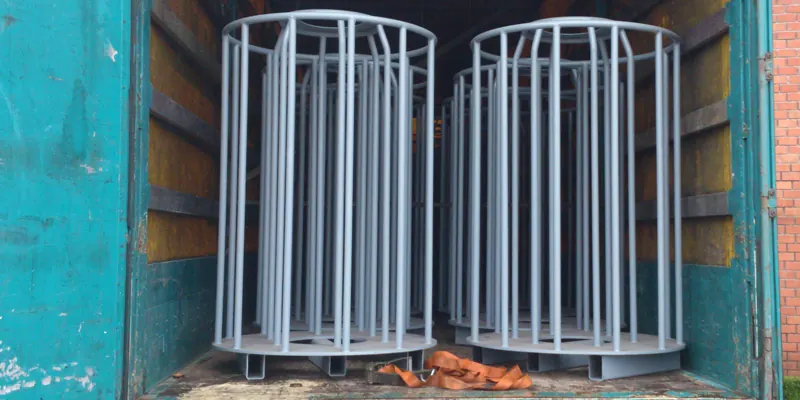
Why? Copper, aluminium and tinned wire is carried to the next process in the same basket. Because the wire is not transferred to another container, the risk of scratches and dents on the soft wire surface is reduced; baskets can be moved by forklift and stacked.
Our other products
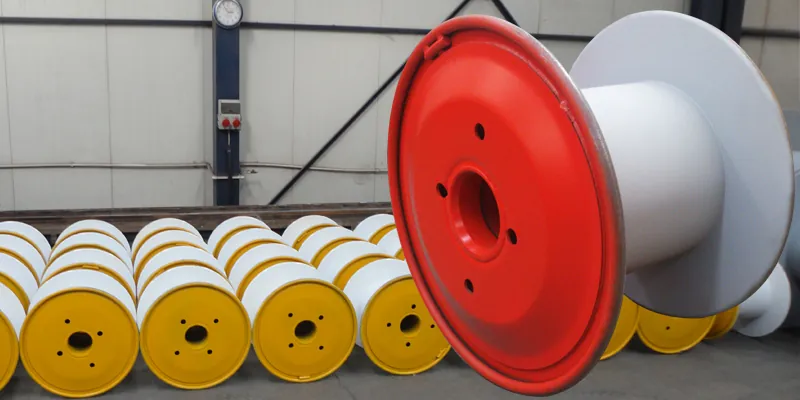 OSG-DOPDOP Type Steel ReelDIN 46395 / 46397
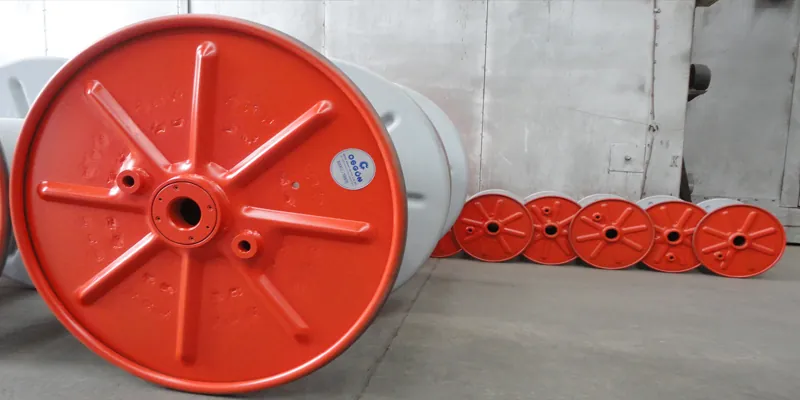 OSG-EXPExport Type Steel ReelDIN 46395 / 46397
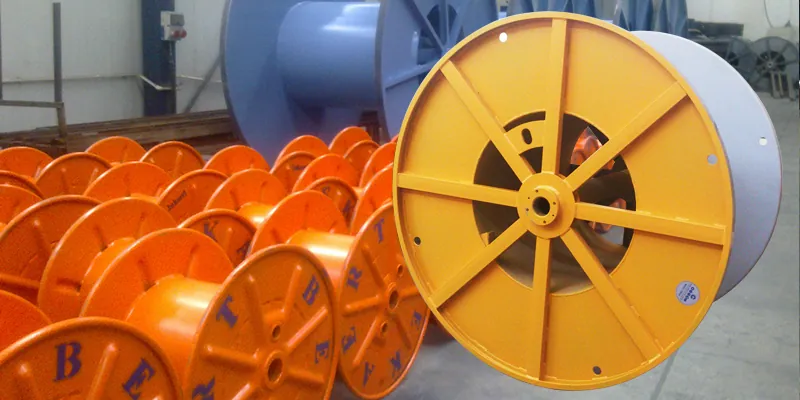 OSG-KIMCable Manufacturing ReelDIN 46391 / 46395
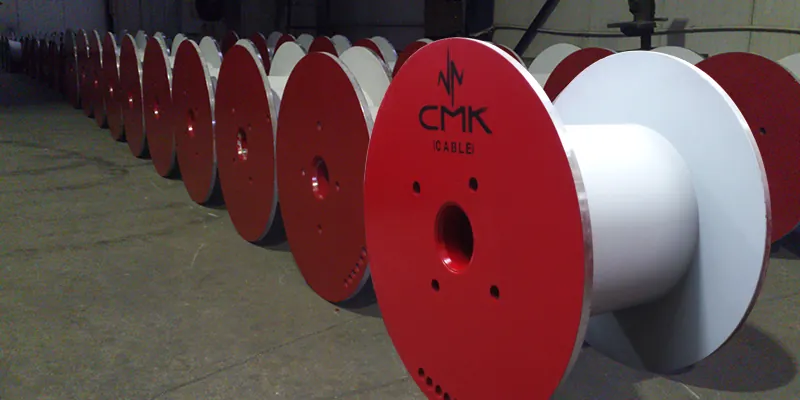 OSG-MASMAS Type Steel ReelDIN 46397
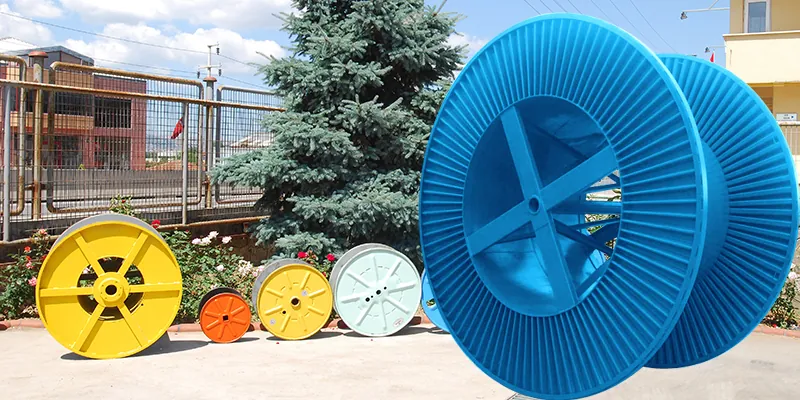 OSG-ONDOND Type Steel ReelDIN 46391 / 46395
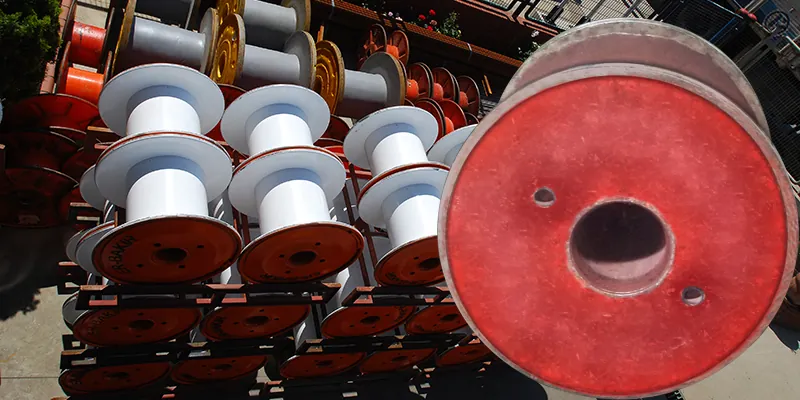 OSG-HDRHDR Type Steel ReelDIN 46395 / 46397
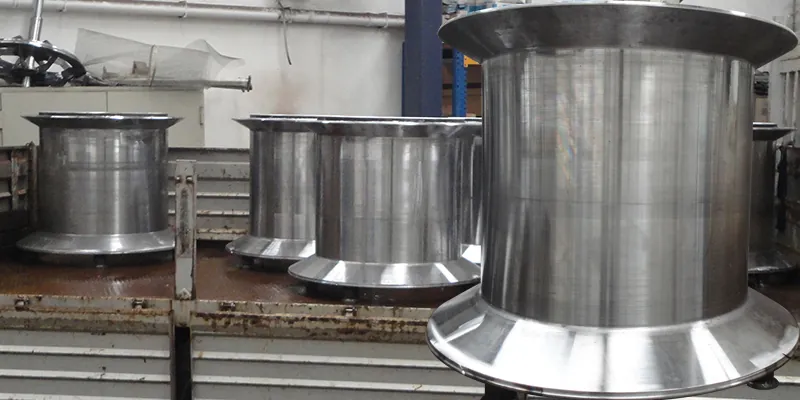 OSG-KOMConical Flange ReelMade to customer dimensions
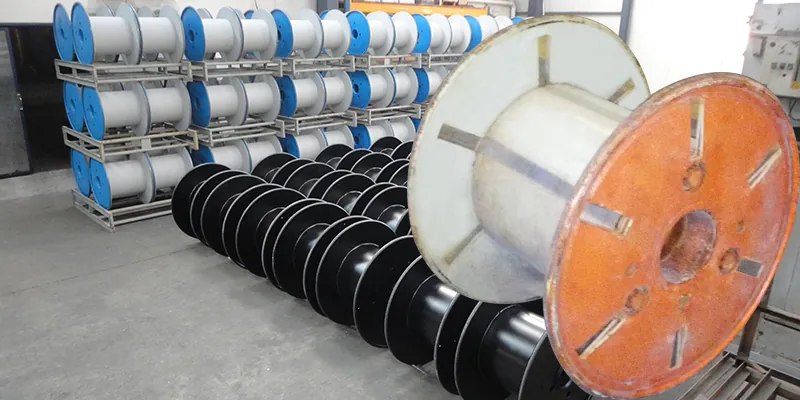 OSG-COLCOL Type Steel ReelDIN 46395
For information
Technical details and engineering notes
Wire basket – the engineering principles behind the design, sample calculations and the relevant standards. The values in the calculations are examples; project-specific values are determined at the quotation stage.
Design principles
Welded cage structure
Vertical bars and perimeter rings form a cage that carries the lateral pressure of the coil. Because the load is carried as tension and compression in the bars rather than bending the material, high strength is achieved at low weight.
Central cone
It sets the inner diameter of the coil and stops the rings from toppling towards the centre. In overhead pay-off it ensures the wire unwinds in sequence without tangling.
Base and stacking feet
The base distributes the coil weight to the feet; the feet are designed to accept forklift forks and to sit on the top ring of the basket below.
Surface and paint
Welds and wire contact surfaces are left smooth so as not to damage soft wire. Paint is applied on request; colour can also be used to tell different wire types apart on site.
Sample calculations
Basket capacity
In the basket, the wire is laid at height H into the annular volume between the inner cone (Di) and the usable outer diameter (Do). For wire laid in rings, the fill factor φ is lower than for layer winding on a reel (typically 0.5–0.6).
Example: Do = 800 mm, Di = 400 mm, H = 800 mm → V ≈ 0.30 m³. With φ = 0.55 this gives ≈ 1,490 kg of copper wire (ρ = 8.96 g/cm³) or ≈ 450 kg of aluminium wire (ρ = 2.70 g/cm³); for 2.0 mm copper wire that is ≈ 52.8 km of wire.
Stacking load
With k baskets stacked on top of each other, the bottom basket carries the weight of all the full baskets above it. The load is distributed over the basket’s n feet:
Example: with a 60 kg basket and 1,490 kg of copper wire stacked three high, the bottom basket carries ≈ 30 kN, or ≈ 7.6 kN per foot in a four-foot design. Because impacts during forklift lifting and setting down increase this value, the feet and top-ring joints are sized with a safety margin.
Thermal expansion during annealing
The length of a heated material increases linearly with the temperature difference (α: coefficient of linear thermal expansion):
Example: for a diameter of 800 mm and heating by ΔT = 480 K, a steel basket (α ≈ 12·10⁻⁶ 1/K) expands by ≈ 4.6 mm and a copper coil (α ≈ 17·10⁻⁶ 1/K) by ≈ 6.5 mm. The design considers this difference together with the clearance between coil and basket; on cooling, the coil contracts more and comes out of the basket easily. The temperatures are examples; actual annealing values depend on the wire type and process.
Relevant standards and references
There is no DIN or ISO product standard for wire baskets; dimensions, load capacity and stacking arrangement are determined by the customer’s line and wire type. For the standards framework of the reels used alongside baskets, see the guide below.
- OSGÜN Technical Guide – What is DIN? DIN 46391, 46395 and 46397 standards for steel reels (in Turkish)
- OSGÜN Technical Guide – What does non-standard steel reel production cost a business? (in Turkish)
This section provides general engineering information and does not replace the standards; their full texts are available from the respective publishers. For exact dimensions, tolerances and capacity values, please contact us via the quote form. You can also review the data sheet (PDF, Turkish).